
Fly Tying:
The Wonderful World of Fabric Paint
with
Peter Caverhill
Peter's
Arcticles...
 What
is great about flyfishing these days is that you can be almost anything
that you desire, and the tools are there to make these dreams come true.
This is so with flytying, where old school traditionalists and new school
revisionists have a happy and desirable place in the scheme of things.
Sure, there may be the odd friendly debate about who is closer to god
with their particular mix of steel and materials but no blood ( or very
little ) spills onto the floor. We all wave our creative offerings over
many different waters and fish, with a great deal of satisfaction. Some
of my more lineal thinking -friends have, on occasion, accused me of using
"lures". I get a real kick out of looking in places that aren’t
oriented specifically to fly fishing for interesting items that may have
utility at the tying bench or on the water. Recently, my infatuation has
been with fabric paint because of it’s potential for use in
tying and other aspects of flyfishing. What
is great about flyfishing these days is that you can be almost anything
that you desire, and the tools are there to make these dreams come true.
This is so with flytying, where old school traditionalists and new school
revisionists have a happy and desirable place in the scheme of things.
Sure, there may be the odd friendly debate about who is closer to god
with their particular mix of steel and materials but no blood ( or very
little ) spills onto the floor. We all wave our creative offerings over
many different waters and fish, with a great deal of satisfaction. Some
of my more lineal thinking -friends have, on occasion, accused me of using
"lures". I get a real kick out of looking in places that aren’t
oriented specifically to fly fishing for interesting items that may have
utility at the tying bench or on the water. Recently, my infatuation has
been with fabric paint because of it’s potential for use in
tying and other aspects of flyfishing.
Fabric paint
may be to the fly tier/fisher what duct tape is to the world :- you know,
a million uses and still counting! I’m sure that others are using
this stuff, but I’ve not seen any reference to it in current books
and periodicals. I got the idea from fly club friends who use it to dob
eyes on minnow patterns for cutthroat trout. That got my few remaining
grey cells motivated to try a number of uses for the paint, and I’m
sure I haven’t exhausted them all, so there is still a lot of room
for innovation.

So why fabric
paint? What will it do? Is it truly a magic elixir?
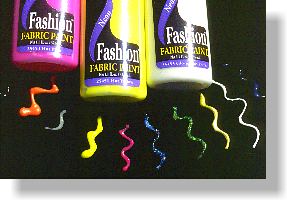
Fabric paint
is the stuff that crafters buy at craft shops to creatively decorate clothing.
Judging from the variety of paints, associated tools and instructional
books, this is a very popular hobby, so supplies of the stuff should be
with us for some time. Fabric paint has a number of advantages for the
flyfishers: it’s reasonably inexpensive ( 20 bucks will get a good
array of colours and types); it’s readily available ( almost all
craft shops); it’s durable and tenacious, and will cling to a variety
of surfaces ( remember it must withstand the rigors of T-shirt life, which
includes the washing machine!); it’s easily dispensed ( the small
bottles have a fine-tipped dispenser from which the paint is applied);
it has great shelf- life ( unlike so many glues and paints, this stuff
never seems to dry-up, and is always ready to flow freely) and it comes
in an astounding selection of types and colours, many of which are ideal
for our use. Fabric paint tends to be rather viscous ( thick) and holds
it’s shape quite well upon application. It dries to shape very quickly
( about 10 minutes) and is ready for touch and use overnight.
The brand
of fabric paint that I’m partial to is manufactured by "Plaid".
It tends to be a little cheaper than some of the other brands, and I like
the dispenser bottle - it’s very easy to use. "Plaid" is
available in several categories according to the final "look"
of the paint and there are a multitude of colours within each category.
The paints most useful to the fly angler within each category are: "Shiny"
( clear - this goes on an opaque white but dries clear, black ) ; "Metallic"
( gold and sterling are solid colours ) ; "Sparkles"( ice, citron
and a variety of others. They have fine sparkles in a clear base - these
are really neat!) ; "Neon" ( red, hot pink, chartreuse - really
bright!) ; "Glitter" ( gold and silver - these are fish scales
without equal!) ; "Pearl" ( white - very "fishy")
and last but certainly not least, - are you ready for it - "Glo-in
-the -Dark" ( whooo - let your mind run free on this one -it should
be illegal! ).


 Now
that we have looked at the properties, advantages and availability of
fabric paint let’s explore some of the many ways that we can use
this stuff to stir our creative juices and make those fish cringe in fear.
On the fly tying side of the fabric paint equation look at these
: Now
that we have looked at the properties, advantages and availability of
fabric paint let’s explore some of the many ways that we can use
this stuff to stir our creative juices and make those fish cringe in fear.
On the fly tying side of the fabric paint equation look at these
:
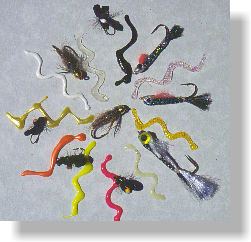
- For baitfish
imitations in salt and freshwater - use this paint ( clear, coloured,
sparkle or glitter ) to coat bodies and heads that have stick-on eyes.
This makes tinsel bodies and eyes very durable. The end result is almost
as good as using 2-part epoxy but with considerably less fuss. For heavily-
coated bodies and heads consider turning the fly to prevent paint sag.
Also, use the paint to dob on bait fish eyes ( try a tapered-end barbecue
skewer, cut to appropriate for a larger round yellow or white iris and
a smaller black pupil).
- For steelhead
and salmon "attractor" patterns in fresh and salt water -
add fluorescent accents, especially to the finished fly heads.Also,
bodies can be coated. Add a dot of colour to the bead on "bead-
head" wooley buggers. The "neon" colours are great for
these applications!
- For freshwater
patterns - try a tiny dob of white or neon on small foam- bodied dry
flies ( ants, beetles, hoppers) to act as "sight assistors"
in poor visibility conditions(which for most of us ageing types is always).
You can also try a bit of sparkle, glitter or glo-in-the-dark on the
bodies of nymphs, larvae or water boatmen patterns, to simulate captured
air bubbles.
For application
to general fly fishing use, try the paints to :
- coat all
types of line /leader/backing junctions for strength and smoothness
- clear is very good for this. It can be used the same as other adhesives,
such as pliobond or aquaseal.
- mark a
flyline tip with the line weight - it can be confusing when we own a
number of fly lines. Some day we’ll lose track of what the line
weight is.The tip of the flyline can be marked with fabric paint, using
a coding system for weight that will provide instant recognition. (
i.e. 6 small dots equals a #6 flyline or whatever symbol system you
may wish to devise ).
- create
a "nymph tip" indicator on a floating fly line - paint the
first few inches of the line with one of the neon colours to assist
line tip visibility for fishing nymphs in streams or lakes. It is a
bit tricky to get really smooth coverage with the paint, so you may
want to experiment on an old bit of line with different applicator tools
( try a small, soft, cheap brush).
- mark fly
boxes and reel spools - the paint works well on these items to create
a durable label of contents ( i.e. "WF#6F" on the back of
a spool or "Dryflies" on the outside of a flybox).
- develop
sinking leaders - if you have access to powdered lead from a chemical
supply place, try mixing a bit of the lead with a fabric paint of your
choice ( probably clear) and coating it onto leader knots and/or sections
( This is a bit extreme, and may be only for those on the outer fringes
of innovation).
For those
who are appearance conscious, there are also a myriad of ways to use the
paint in its traditional manner to make a fashion statement. Try
decorating shirts, wader belts or other articles of clothing with painted
flies, fish or your own logo.
Using fabric
paint as a magic elixir may be the product of an overactive imagination
but you will have to admit that there are some useful attributes for it
in the world of fly fishing. I suppose that some that will cringe in disgust
and opt for the less interesting route of the tried and true, but whay
not give it a whirl and report back!
Peter's
Arcticles...
|